





Need help? Call 01943 608596 or contact us
Diary of a First World War Nurse
|
Author: WOMAN NURSE
Title: Diary of a First World War Nurse
Year: 1917
Publisher: Unpublished
Place: Calais & Wimereux, France
Dust Jacket: No
Signed: No
Price: £450
Buy over the phone - call 01943 608596
Postage (UK): £0
Postage (Europe): £0
Postage (Worldwide): £0
Added under
Manuscripts
|
Gassed 'Tommies'; improvised cemeteries, and airraids: the journal of a censorious young woman who nurse in northern France during Passchendaele in the summer of 1917.
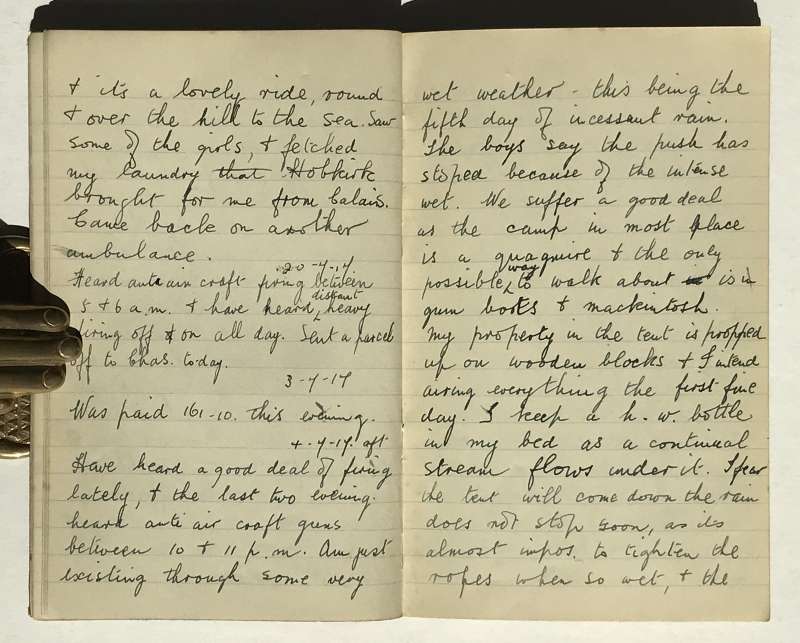
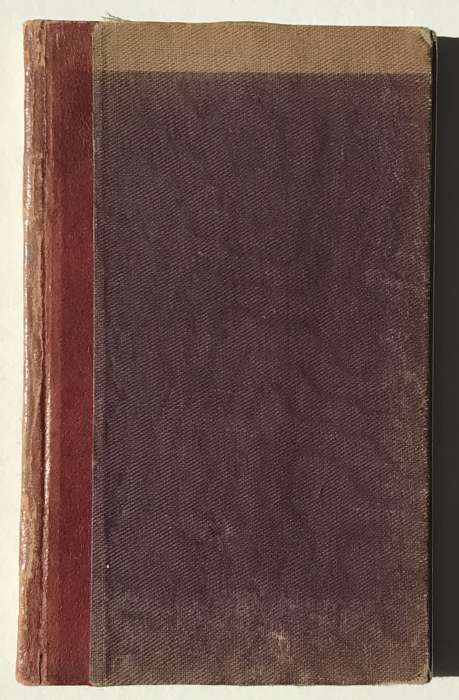
Small octavo lined notebook bound in quarter red paper over textured cloth, fading but a very good binding. Stationer's label to first pastedown: 'Albert E Sparrow... 7 High Holborn'. The diary runs to 34 pages from 23 April 1917 to August 8th and is written in a clear hand in blue black ink before breaking off suddenly.
Beginning in April 1917 the young woman begins with the disappointment of arriving in France but finding herself unable to proceed to the 53rd General Hospital in Wimereux near Boulogne: 'This planting of a new Hospital staff out here, before the Hospital is ready, is very disgusting' - she is no less forgiving of 'forward' young French women whom she witnesses forcing themselves on her 'Tommires'.
More sobrely, the writer records her first experiences of seeing injured men departing from Calais where she finds herself working in a camp hospital 'on the sands by the canal, and the hospital comprises long tents of over 40 best and huts of beds... There is a tent for sick and injured prisoners - ie soldiers who have offended against military law... we six nurses sleep in a marquee... 2 sheets and 3 blankets... They seem rather careless as to whether things are antiseptic here.' In the journal she considers the problem of removing bloodied clothing and records her visit to a military cemetery, especially 'the part where our Tommies are buried, which were the rows of plain wooden crosses, raised mounds, suare, with turf edges. Names etc on tin in centre of cross.'
While still in Calais she experienced her first airraid 'Many search lights sweeping the sky, and at first the banging and whizzing was most terrifying. When we got more used to the noise we crept to an opening in the marquee, and crouching on the ground looked round.'
The writer arrived in Wimereux in July 1917: 'We have really got to our own hospital, the 53rd at last.. A camp hospital and mostly under canvas at present, though wooden and corrugated buildings are going up fast...' Her final entries record the casualties - 'trains of wounded and sick stream in' - from the Third Battle of Ypres or Passchendaele: 'the boys say the push has stopped because of the intense wet... the camp in most places is a quagmire... I keep a h[ot]w[ater] bottle in my bed as a continual stream flows under it.' It is during these final pages that she first encountered victims of gas attacks: 'In my wards we have a lot of gassed men - the particular kind of gas that Fritz is using now causing running at the eyes, sneezing and sickness about 12-24 hours after gassing... The eyes become very blood shot and for a while are shut tightly... The throat burns... The patient, if the attack is severe finds it difficult to swallow.' The diary breaks off suddenly early August 1917.
Enquire about this book,
buy this book securely online now or call
01943 608596 for help and information.